Nobody knows who has the trailer.
When your gear is your business, a handshake isn't a system. This kit is the ledger: who has what, when it's due back, what deposit is held, and who keeps returning things late. Due-back reminders send themselves, double-booking gets refused before you promise the same trailer twice, and every deposit has a paper trail. Works for gear you lend to your crew and gear you rent out for income.
Some setup. The guide walks you through it.
- Price
- $75 · once
- Inside
- 18 files, source + README
- Tests
- 67 automated
- Needs
- Python 3.9+
Encrypted payment, powered by Stripe.
Rather have us set it up? Done for you, $499, live in 5 business days. Request setup →
This is the ZIP.
Every file, before you pay.
- Files
- 18 files in one ZIP
- Tests
- 67 automated tests
- Guide
- Setup README included
- Payment
- One payment, ever
- You need
- Runs on Mac, Windows or Linux with Python 3.9 or newer (free). On a Mac your passwords stay in the keychain; on Windows and Linux, in an environment variable. Never in a file.
Gear-Ledger-Kit.zipSee all 18 files
- businesses/2 files
- example-rentals.json
- your-business-here.json
- src/5 files
- cli.py
- creds.py
- engine.py
- send.py
- + 1 more
- tests/8 files
- test_cli.py
- test_creds.py
- test_customize.py
- test_deposit.py
- + 4 more
- CUSTOMIZE.md
- README.md
- requirements-dev.txt
The full fileWhat it does, every part, and questions
What it does about equipment chaos.
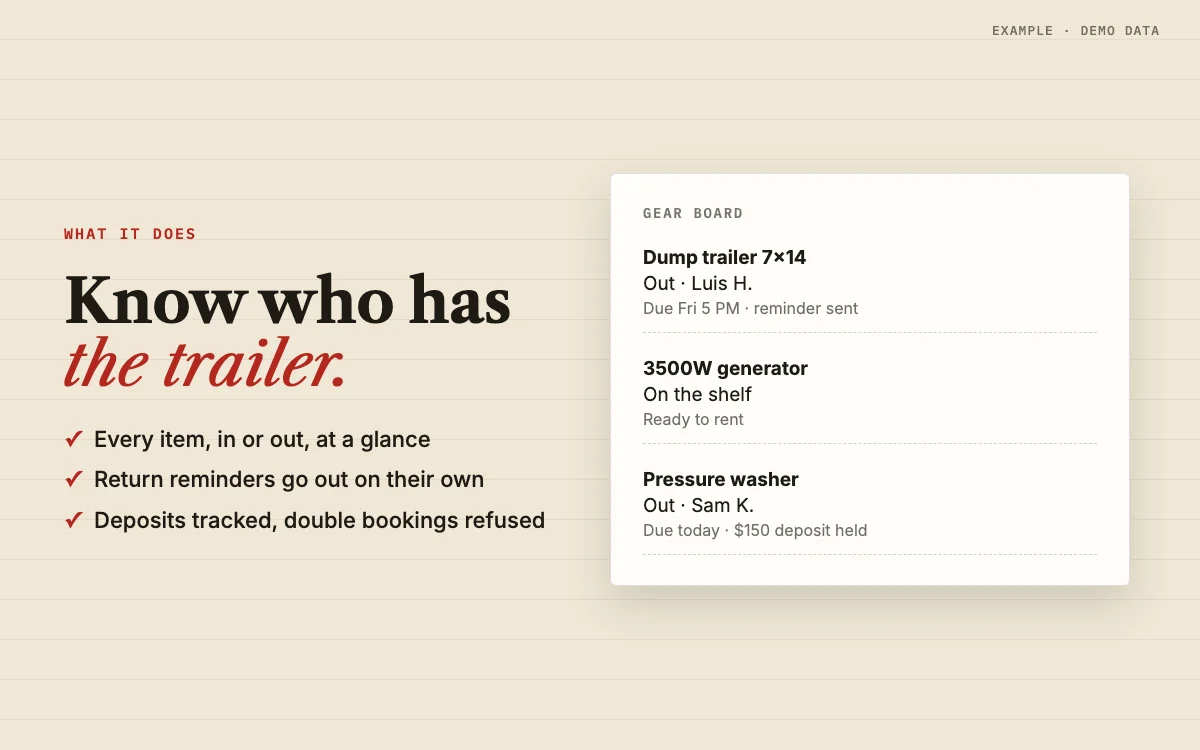
- One lookup replaces the group text. Every item's live status (on the shelf, or out to whom until when) from a single command. 'Where's the generator?' stops being a conversation.
- Due-backs that chase themselves. A heads-up before the return is due and one overdue notice after (email or SMS, in your voice), so returns stop depending on anyone's memory.
- Double-booking refused at booking time. The kit checks the item's open loans before it lets you promise it. The conflict surfaces when you book, not at 7 AM when two crews show up.
- Deposits with a paper trail. Held at check-out, resolved at check-in: returned, or withheld with a written reason. The record that settles the dispute later.
- It remembers who burns you. Late returns, damage, and withheld deposits per borrower, worst first, so the lending decision is data, not vibes.
- Own it: yours forever, no subscription required. Real Python source, on your machine. Configure it for your own operation (or your clients') and resell it. No per-seat fee, ever.
What's inside.
Your gear, on the record
Every item with its deposit, daily rate, and live status. Add it once; the ledger tracks it forever.
Conflicts caught at booking
Booking checks the item's open loans and refuses a colliding window. Override with --force only when you know better.
Due-back nudges
A T-24h heads-up (configurable) and one overdue notice, sent automatically when you run `due` on a schedule. Email or text. US texting needs A2P 10DLC registration with Twilio. Approval can take a few days to a few weeks, and Twilio charges a one-time fee plus a small monthly fee for it. The README walks you through it.
Held, then resolved
Every deposit is logged at check-out and closed at check-in: returned, or withheld with the reason written down.
A few commands
`init` makes it yours, `add` builds the inventory, `book`/`checkin` run the ledger, `due` sends reminders, `history` shows who flakes.
Never in a file
On a Mac, credentials live in the keychain; elsewhere, in an environment variable. Never a plaintext file. The whole ledger is auditable in a text file.
One command and it's your business, not ours.
The kit ships with a blank template. Run init with your business name and it writes your own config. Every reminder now goes out as you, on your channel, with your late policy in your words. Nothing points back to this shop. If you set up tools for other businesses, it's yours to configure per client and charge for.
Encrypted payment, powered by Stripe.
Own it: download once, yours permanently. No subscription required.